Amazon ECS vs EC2: The Primary Differences
Amazon EC2 and ECS serve different compute needs – EC2 provides full infrastructure control, while ECS simplifies containerized workloads. This guide breaks down their key differences and use cases.
Selecting the right compute service in AWS is a challenge for businesses balancing scalability, management overhead, and cost efficiency. Some workloads require full control over virtual machines, while others benefit from automated container orchestration.
EC2 gives complete infrastructure control, but managing instances, scaling, and updates can be time-consuming. ECS automates containerized workloads, reducing operational complexity but with different flexibility and pricing considerations.
Understanding the differences between EC2 vs ECS is crucial for optimizing performance and costs. This guide breaks down their key features, use cases, and how to choose the right fit. Read on!
What Is Amazon EC2?
Amazon Elastic Compute Cloud (EC2) is a cloud-based virtual machine service that provides on-demand compute capacity. It allows businesses to deploy, configure, and scale virtual servers (instances) with complete control over the operating system, networking, and security settings. Unlike managed services, EC2 offers granular control, making it ideal for workloads that require **custom configurations, **persistent compute environments, or high-performance processing.
 Image Source:AWS
Each EC2 instance type follows a structured naming convention as stated in the above image, where the instance family, generation, and size indicate the compute, memory, storage, and network capabilities.
Key Benefits of EC2
- Scalability – Scale instances up or down based on demand, either manually or using Auto Scaling Groups.
- Infrastructure Control – Customize instance types, OS, storage, and networking to match workload needs.
- Flexible Pricing Models – Optimize costs with On-Demand, Reserved, Spot Instances, or Savings Plans.
- Diverse Instance Options – Choose from general-purpose, compute-optimized, memory-optimized, and GPU instances for different workloads.
Use Cases for EC2
- Custom Applications – Workloads that require full OS and infrastructure control.
- Web Hosting & Databases – Running high-availability web applications and relational databases.
- Machine Learning & HPC – Compute-heavy applications that need powerful processing and storage performance.
- Legacy & Enterprise Applications – Supporting traditional monolithic applications that are not containerized.
What Is Amazon ECS?
 Image Source:AWS Documentation
Amazon Elastic Container Service (ECS) is a fully managed container orchestration service that simplifies deploying, managing, and scaling containerized applications. Instead of provisioning and maintaining virtual machines, ECS allows businesses to run Docker containers without managing underlying infrastructure. It integrates seamlessly with AWS services like Elastic Load Balancing (ELB), AWS IAM, and CloudWatch, making it a preferred choice for scalable, microservices-based architectures.
Key Benefits of ECS
- Simplified Management – Automates container deployment, scheduling, and scaling.
- Flexible Compute Options – Run containers on EC2 instances (self-managed) or AWS Fargate (serverless).
- Built-in Scaling – Dynamically scale containers based on demand without manual intervention.
- Deep AWS Integration – Works with IAM for security, ALB for traffic routing, and CloudWatch for monitoring.
Use Cases for ECS
- Microservices Applications – Deploying and managing distributed containerized workloads.
- Serverless Workloads – Running containers without managing servers using AWS Fargate.
- Batch Processing & CI/CD Pipelines – Automating container-based workloads and software deployments.
- Web Applications & APIs – Hosting scalable, containerized backend services with minimal operational overhead.
Key Differences: Amazon ECS vs EC2
The table below highlights primary differences between ECS and EC2 across various aspects:

And this table focuses on secondary differences between ECS and EC2:

Comparison of Hosting Containers on EC2 vs. ECS
The main difference between running containers in ECS and EC2 is how much management and automation you get:
- ECS: A fully managed service that automates deployment, scaling, and orchestration of containers across EC2 instances. It’s easier to use, especially with Fargate (serverless containers), and scales automatically.
- EC2: Gives you full control over the EC2 instances running your containers. You manually manage container deployment, scaling, and orchestration, which offers flexibility but requires more effort.
At Stormit, we recommend using ECS for most containerized applications. It takes the heavy lifting off your shoulders by automating deployment, scaling, and orchestration, which can save you time and reduce operational complexity. With ECS, you also get the flexibility of using Fargate, a serverless option that completely abstracts away the infrastructure.
Ready to optimize your container strategy? Contact us to discuss how we can help you choose the best solution for your needs.
How to Choose the Right Fit: Amazon EC2 vs ECS
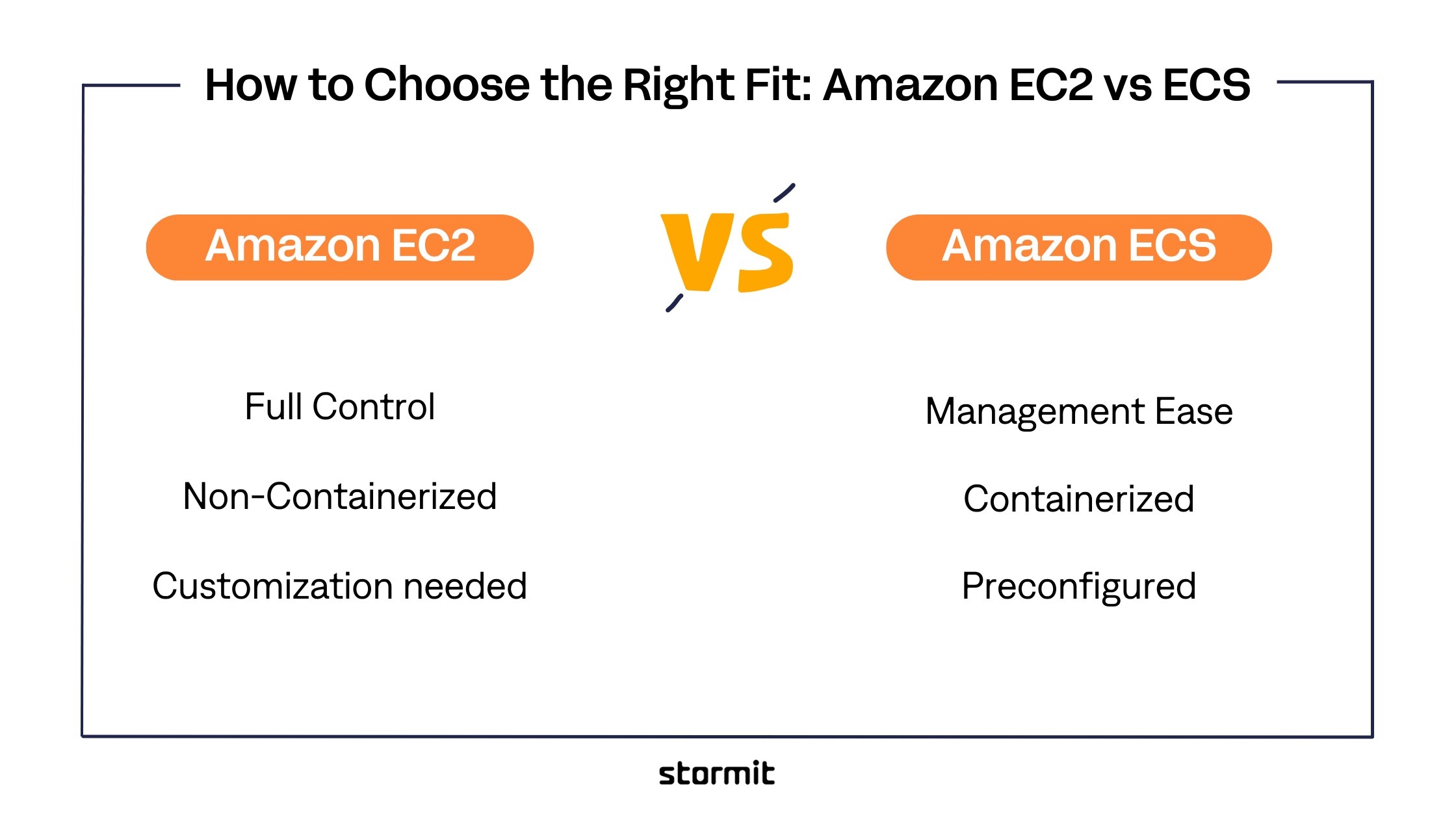
The decision between Amazon EC2 vs ECS depends on workload requirements, management preferences, and scalability needs. Each service is suited to different use cases, and choosing the right one comes down to how much control, automation, and flexibility your applications need.
When to Choose EC2
- You require full control over the operating system, instance configurations, and networking.
- Your workloads include custom software, databases, or legacy applications that are not containerized.
- You need dedicated GPU or high-memory instances for machine learning, big data, or HPC workloads.
- You are comfortable managing server provisioning, scaling, and maintenance.
When to Choose ECS
- Your applications are containerized, and you want automated orchestration to manage deployments.
- You prefer less infrastructure management and want AWS to handle scheduling and scaling.
- You need a cost-effective, scalable architecture without worrying about over-provisioning EC2 instances.
- You want to integrate seamlessly with AWS services like ALB, IAM, and CloudWatch.
The Hybrid Approach
Many organizations use both EC2 and ECS – running containerized workloads on ECS with EC2 instances for custom infrastructure control or using ECS with Fargate to eliminate management overhead. The best fit depends on how much control and automation your workloads require.
Conclusion
There is no single right way to build and run workloads in AWS – it all comes down to adaptability. Whether you choose EC2 for control or ECS for automation, the real challenge is ensuring that your infrastructure scales efficiently without unnecessary complexity or cost overruns.
As cloud environments evolve, so do the tools and strategies needed to manage them. Instead of thinking in terms of EC2 vs. ECS, the better question is: How can you align your infrastructure choices with long-term growth and efficiency?
As you continue to develop and optimize your cloud strategy, follow Stormit’s blog for more valuable content on cloud technologies and best practices.

An AWS Solutions Architect with over 5 years of experience in designing, assessing, and optimizing AWS cloud architectures. At Stormit, he supports customers across the full cloud lifecycle — from pre-sales consulting and solution design to AWS funding programs such as AWS Activate, Proof of Concept (PoC), and the Migration Acceleration Program (MAP).