A Comparison of Private Cloud Security & Public Cloud Security
When it comes to cloud computing, security is always the top priority. It is one of the biggest factors influencing a company's cloud strategy. There are more than just a few differences between private and public cloud security. The following blog post takes a look at both to help determine which type of cloud is more secure.
What is meant by cloud security?
Cloud security is a network security discipline dedicated to protecting cloud computing systems. This includes maintaining data privacy and security on online-based infrastructure, applications, and platforms. Protecting these systems involves the efforts of cloud providers and the customers who use them, whether they are used by individuals, small and medium businesses, or enterprises.
Cloud security can be divided into the following categories:

- Data and storage security - protecting storage resources and the data stored on them from accidental or deliberate damage.
- Identity and access management (IAM) - defining and managing the roles and access privileges of individual network entities.
- Governance - defining policies to control costs and minimize security risks.
- Disaster recovery and business continuity planning - preventive measures during a disaster and streamline the flow of operations after any damage or disaster.
- Compliance - following industry guidelines and local, national, and international laws.
Private cloud security
Advantages:
- Security - your data and applications remain behind your firewall and are accessible only to your enterprise, making private clouds better suited to processing or storing sensitive data.
- Fully enforced compliance - private cloud customers aren’t forced to rely on the industry and regulatory compliance offered by the cloud service provider.
- Greater visibility into security and access control - because all workloads run behind the customers’ own firewall.
- Flexibility in using hybrid cloud - ability to move non-sensitive data to a public cloud to accommodate sudden bursts of demand on your private cloud.
Disadvantages:
- Higher costs at the start - increased initial charges and the need to repay the costs of the equipment you purchase.
- Responsibility - for operating and maintaining your own data center, IT hardware, and enterprise software as well as your own security and compliance.
- Less flexibility - in scaling IT resources up or down as your needs change.
Private cloud security risks
1. Overall security
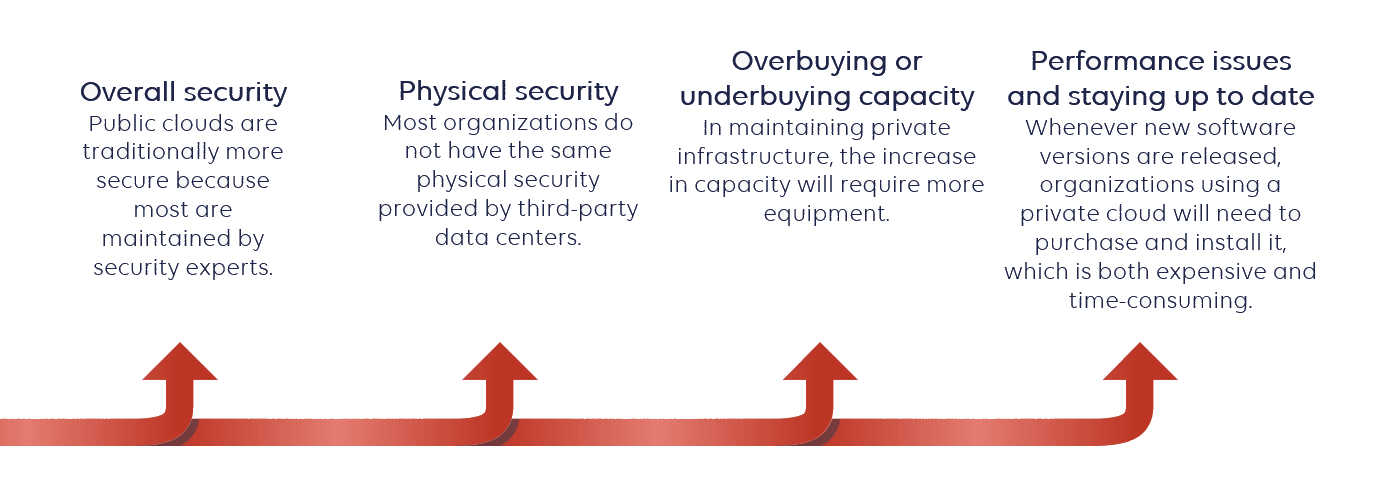
Many organizations believe that their sensitive data is more secure in a private cloud. However, the reality is that public clouds are traditionally more secure because most are maintained by security experts who understand cloud security challenges and how to mitigate them. To satisfy customers, reputable public cloud providers usually spend more time on this field than any single organization to obtain this level of reliability and security.
2. Physical security
Most organizations do not have the same physical security (cameras, fire protection, security guards) provided by third-party data centers, which may make their data vulnerable to various threats. Many public providers also provide geographically redundant data centers, which means they have facilities throughout the state or the country.
3. Overbuying or underbuying capacity
The private cloud infrastructure is not the "cloud" as we know it. The true definition of the cloud is that it is elastic and scalable. In maintaining private infrastructure, the increase in capacity will require more equipment. If you don't buy enough capacity and your application traffic becomes too large, it could make your application very slow to load or bring it down and offline.
4. Performance issues and staying up to date
Whenever new software versions are released, organizations using a private cloud will need to purchase and install it, which is both expensive and time-consuming. Some may continue to run on outdated software, which could then expose them to vulnerabilities. This can lead to downtime and also affects performance.
Public cloud security
Advantages:
- Scalability (both up and down) - almost unlimited due to on-demand cloud resources.
- Lower capital expenditure (CapEx) - you don’t need to purchase all your own data center equipment.
- Reliability - due to services distributed across multiple data centers.
- Security features and services – a vast number of features and services for you to use with everything prepared for a wide range of types of use cases and compliance.
Disadvantages:
- Higher operational expenditure (OPEX) – as you scale performance it can be difficult to control your cost-per-hour.
Public cloud security challenges and risks

1. Data security
Most companies that use the cloud initially believe that protecting their data is the responsibility of their cloud provider. However, this is not the case. Cloud service providers only cover the security of the cloud itself but do not protect customer data or the use of its infrastructure and applications by customers.
Companies are faced with the need to be responsible for their data security in the cloud, and possibly customer data security too.
2. Internal threats
Controlling data in the cloud also depends on the organization's ability to control who can access it. Most threats to data hosted in the cloud come from compromised internal accounts.
Your trusted employees, business partners, and contractors may be some of your potential security risks.
3. Compliance
Conditions for managing compliance and regulations via on-premises hardware are usually more distinct than in the public cloud. It requires a considerable amount of time to create a compliant environment. A company usually needs to hire a team or use a service that can help with compliance and regulations.
4. Backup plan
The backup plan is supposed to complement the data plan by providing security and integrity. The consequences of not having one can be data loss or the inability to protect cloud-based data and applications.
Make sure that your cloud provider offers adequate security controls, and that their backup plan is adequate.
5. Services interruptions
Hardware and network problems happen. Even in high availability environments, sporadically you may encounter an interruption in the contracted cloud services.
Server failures, human errors, intrusions, or hardware/software updates can always cause collateral damage.
6. Misconfiguration
Incorrect configuration of services can be a major security risk as it can make the cloud vulnerable to various attacks. This can cause data to be publicly exposed, manipulated, or even deleted.
Stormit team helps organizations protect their websites and applications against all commonly known attacks and exploits by leveraging the protection of AWS Edge Services, such as Amazon CloudFront CDN, AWS Shield, AWS Web Application Firewall (WAF).
Private vs public cloud security
Why are private clouds less secure?
Implementing good security processes
The first shortcoming of private clouds is that a lot of companies believe that their firewall and antivirus software will work as expected. If their employees use e-mail or access the internet, they can easily download malware or ransomware from their mobile phone or e-mail. Strong measures must be taken. The combination of security with data management and backup/disaster recovery ensures that the private cloud works the way you expect.
Patching and up-to-date security features
The next shortcoming is that your company may lack the expertise to create the cloud you envision. The most advanced tools do not necessarily mean you have the most advanced protection. If you choose a private cloud, make sure that you have a partner with experience in this field. Another disadvantage of private clouds is patching. You may not have a team at all times to keep up with the patches needed for security.
Finally, consider if your private cloud can keep up with the latest technology or if it needs to. How are you protecting it and how often can you afford to update security? Public clouds may have an advantage over private clouds in this area because they share the cost. As a result, they can continuously improve their security.
Why are public clouds more secure
Economies of scale
Public clouds usually have more up-to-date security features than private networks. Because the public cloud obtains stable income from many customers at the same time, it is a crowdfunding upgrade. Each customer only bears a small part of these upgrade costs. This is a huge benefit for businesses that do not have the budget to upgrade security hardware or continuous software patches.
Fully tested
Believe it or not, public clouds have also become more secure because they are being attacked more and more. The obscure advantages enjoyed by private clouds only come into play when the business grows beyond a certain capacity. To continue operating, they must adapt quickly. Therefore, the public cloud puts their business one step ahead of malicious hackers. Thousands of hackers have tried to invade Amazon Web Services (AWS) for years but have rarely succeeded.
Security experts
Public cloud providers also "crowdsource" the best security talent. The best cloud security experts are notorious for their work at Amazon or other major cloud service providers. As a result, when you use a public cloud, you can get an entire team of elite security experts at a much lower price than hiring an in-house expert.
If you are still running your workloads on-premises, read our article to find out what are the benefits of migrating to the public cloud and key aspects to consider: Cloud Migration Strategy With Stormit: How to Do it Right
Hybrid cloud
A hybrid cloud integrates on-premises infrastructure, private cloud services, and a public cloud. In this blog post, we are only talking about the private and public cloud model. To make the best use of this type of cloud computing, you must rely on orchestration tools and services that allow it to move workloads seamlessly across the environments to meet performance, cost, compliance, and security requirements.
Is the hybrid cloud right for you?
Hybrid cloud with an on-premises and public cloud architecture can be a good start for a lot of companies. But not everything belongs to the public cloud. Hybrid clouds provide the advantages of public and private clouds, and can leverage the existing architecture of the data center.
Hybrid cloud scenarios
- Separating critical workloads from less-sensitive workloads. You might store sensitive financial or customer information on your private cloud, and use a public cloud to run the rest.
- Moving to the cloud incrementally, at your own pace. Put some of your workloads on a public cloud or on a small-scale private cloud. See what works for your company.
- Temporary processing capacity needs. A hybrid cloud lets you allocate public cloud resources for short-term projects.
- Flexibility for the future. No matter how well you plan to meet today’s needs, you won’t know how your needs might change next month or next year.
Conclusion
So which should you choose, public cloud, private cloud or a hybrid cloud? It depends on your use case. Your best course of action is to match the advantages and disadvantages of each type with your business needs. These go beyond security and extend to financial considerations.
Stormit's cloud security experts provide you with the help you need to make cloud security decisions that suit your business and workload. We are here to ensure the security of your data and applications.

An AWS Solutions Architect with over 5 years of experience in designing, assessing, and optimizing AWS cloud architectures. At Stormit, he supports customers across the full cloud lifecycle — from pre-sales consulting and solution design to AWS funding programs such as AWS Activate, Proof of Concept (PoC), and the Migration Acceleration Program (MAP).