
Connecting Cetin: Achieving Low-Latency with AWS Direct Connect
Explore how Stormit helped Cetin bridge the gap between their Belgrade data center and the AWS Frankfurt region, achieving a stable 30ms response time through a dedicated Direct Connect architecture.
ClientCetin Telenor
PublishedMarch 2026
IndustryTelecommunications
Websitecetin.cz
As Cetin evaluated the migration of critical workloads to the cloud, they required a high-performance network link that the public internet couldn’t guarantee. Stormit implemented an AWS Direct Connect, delivering a stable connection between Belgrade and Frankfurt to ensure a successful, enterprise-grade transition.
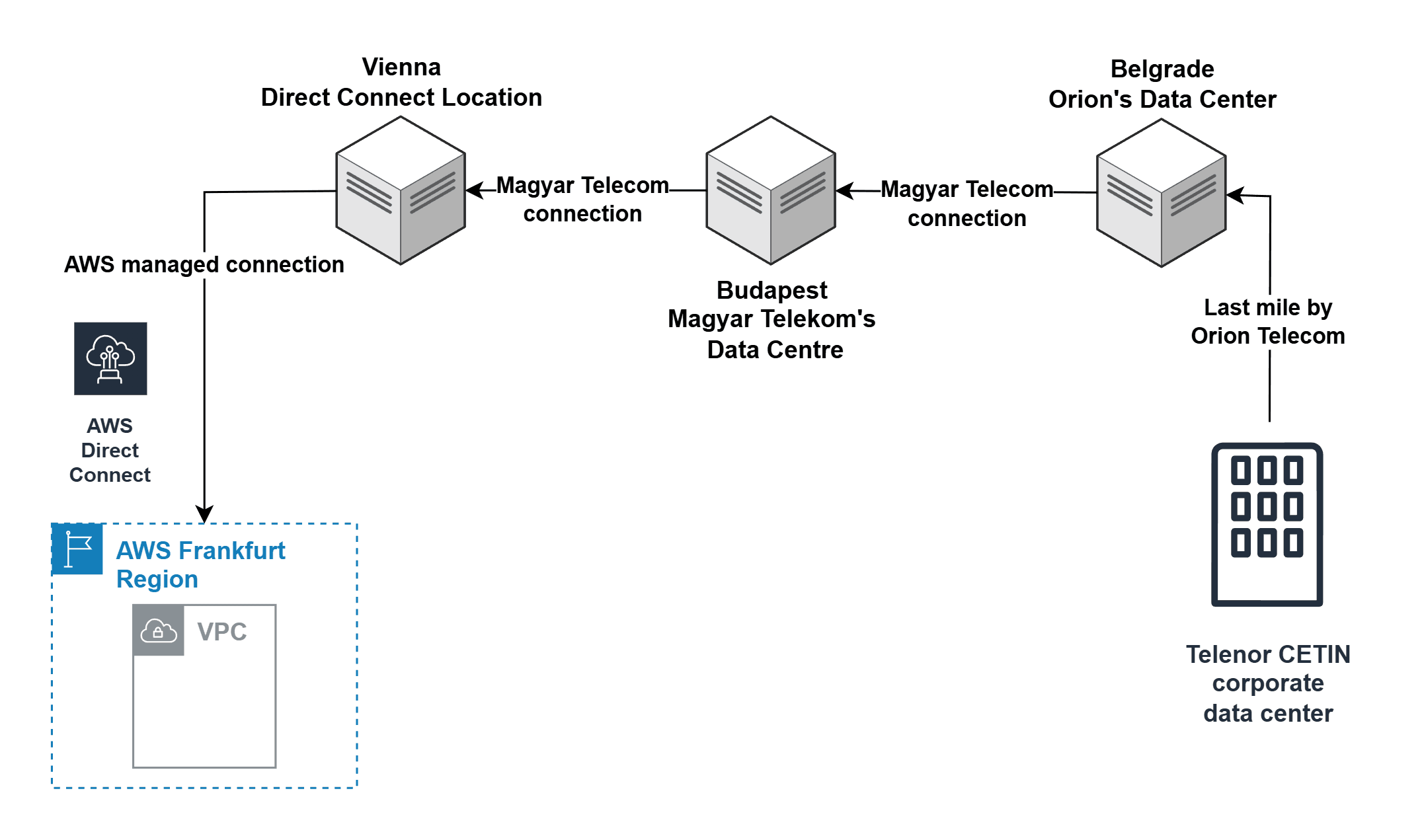
Cetin is a leader in telecommunications, evaluating advanced cloud-based solutions to modernize their operations. This project focused on the Cetin (Telenor) Belgrade Datacenter and its connectivity requirements to global cloud regions. They partnered with Stormit to facilitate a high-performance migration to the AWS cloud environment.
The client needed to migrate critical workloads to AWS while ensuring high-performance, stable connectivity between their Belgrade data center and the AWS Frankfurt region.
A primary concern was achieving consistent two-digit millisecond response times to support enterprise-grade SaaS applications.
Standard public internet connections were deemed insufficient due to potential instability and significant latency deviations that could impact performance.
The physical network route was complex, requiring managed handoffs across multiple international borders, including Serbia, Hungary, and Austria.
Ultimately, the client required a dedicated, private connection that could provide predictable throughput and latency far superior to the public internet.
To address these needs, Stormit implemented an AWS Direct Connect service. The solution established a dedicated private virtual interface connecting the Belgrade to the AWS Frankfurt region via a Direct Connect location in Vienna.
The PoC successfully demonstrated that AWS Direct Connect could meet the client’s strict technical requirements for low-latency communication. Testing confirmed consistent RTT values of approximately 30ms, successfully reaching the target of two-digit millisecond performance. The environment also achieved a stable throughput of 94.6 Mbit/s, providing the necessary bandwidth for initial enterprise workloads.
Within the AWS Frankfurt region, the architecture leveraged managed networking services such as Amazon VPC, Virtual Private Gateways, and Security Groups. Extensive performance testing was conducted to validate Round Trip Time (RTT) and throughput stability. This dedicated line bypasses the public internet, ensuring a consistent and secure path for data transfer between the corporate data center and cloud resources.
The results provided the analytical verification needed to move forward with full-scale deployment. The successful testing phase paved the way for the scheduled migration of the first production workloads to AWS.