AWS Security Agent: What It Is, How It Works, Use Cases, Pricing, and Limitations
The AWS Security Agent is an emerging AWS service that delivers continuous, context-aware security across the application lifecycle. By combining design reviews, code analysis, and on-demand penetration testing, it helps teams identify real, exploitable risks earlier, without relying on periodic testing or isolated tools.
In modern AWS environments, the challenge is no longer detection, but prioritization amid too many signals. The security agent AWS approach addresses this by embedding security directly into development workflows.
In this article, you’ll learn:
- The AWS Security Agent is an AWS service that provides continuous, context-aware security across design, code, and deployed applications.
- Traditional application security struggles in AWS because infrastructure, permissions, and exposure change continuously, often outside release cycles.
- The security agent AWS approach differs from SAST, DAST, and manual testing by combining automation with real application context and on-demand validation.
- AWS Security Agent integrates with GitHub and AWS environments to embed security directly into development and deployment workflows.
- The AWS Security Agent pricing model is based on task-hours for penetration testing, scaling with application complexity and usage.
- Many organizations rely on AWS partners like Stormit to optimize configuration, reduce alert fatigue, and translate findings into business-relevant risk.
Why AWS Security Agent Exists: When Security Can’t Keep Up with AWS
Modern AWS environments are highly dynamic, with constant changes across code, configuration, and permissions. Traditional AppSec, built on periodic testing and manual reviews, can’t keep up, and even small changes can introduce immediate risk without code updates.
At the same time, architectures span microservices, serverless, and multiple accounts, increasing complexity while reducing visibility. The result is a gap between development speed and security coverage, with vulnerabilities often discovered too late.
Meanwhile, AWS-native tools generate large volumes of findings, but teams still struggle to prioritize what is exploitable and business-critical. The AWS Security Agent addresses this by adding context and continuous validation, helping teams focus on what matters.
What Is the AWS Security Agent?
The AWS Security Agent is an AWS service that brings continuous, context-aware security into the application lifecycle. It combines design reviews, code analysis, and penetration testing to surface real, exploitable risks, not just theoretical issues.
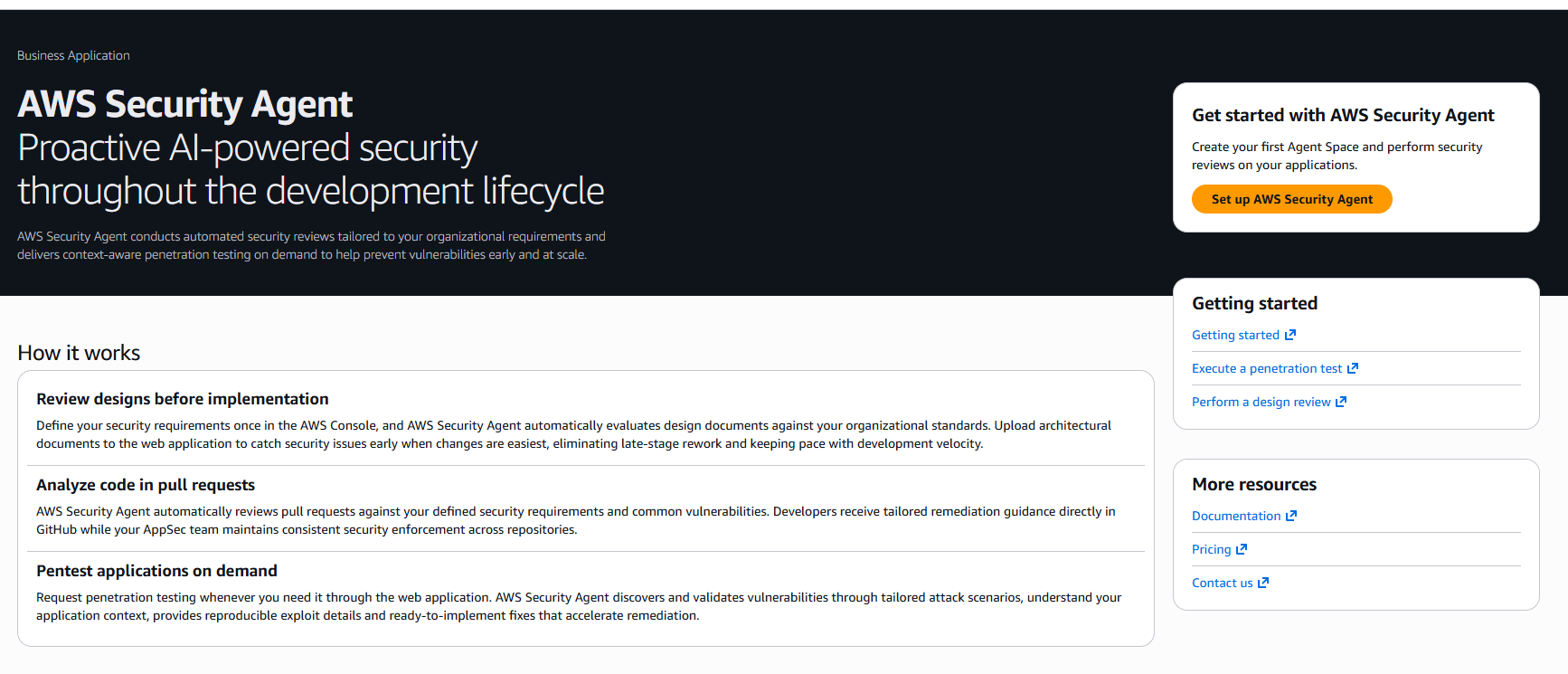
Unlike traditional tools that work in isolation, it looks at applications in context, factoring in architecture, code, runtime behavior, and your organization’s security requirements. These requirements are defined centrally in the AWS Management Console and automatically validated across applications.
The key difference is its focus on what actually matters. Instead of flooding teams with alerts, it helps determine whether an issue is truly exploitable by considering exposure, data flow, and realistic attack paths.
It also doesn’t replace tools like Inspector or GuardDuty. Instead, the AWS Security Agent* *complements them by focusing on application-layer security and developer workflows.
How the AWS Security Agent Differs from Traditional Security Tools
The AWS Security Agent is built on context-aware analysis, continuous validation, and automation at scale, marking a shift from traditional tools that operate in isolation and at fixed points in time.
AWS Security Agent vs SAST
SAST (Static Application Security Testing) analyzes source code without execution. It can detect issues like missing input validation, but lacks runtime context, meaning it cannot determine whether code is actually reachable or exploitable.
The AWS Security Agent evaluates code in context, considering deployment, exposure, and real attack paths, helping teams focus on risks that matter in production.
AWS Security Agent vs DAST
DAST (Dynamic Application Security Testing) tests running applications from the outside, identifying exposed endpoints. However, it lacks visibility into internal architecture, business logic, and data flows.
The security agent AWS approach combines external testing with internal context, enabling multi-step, realistic attack scenarios that reflect how vulnerabilities are actually exploited.
AWS Security Agent vs Manual Penetration Testing
Manual penetration testing is effective but slow, expensive, and hard to scale, so it is typically performed only at specific points in time.
The AWS Security Agent makes testing on-demand and repeatable, allowing teams to validate security continuously instead of relying on periodic assessments.
Core Capabilities of AWS Security Agent
The AWS Security Agent provides continuous, context-aware application security across design, code, and deployed applications, helping teams move from reactive detection to proactive validation.
Design Security Review
Analyzes architecture and design documents against organizational security requirements defined in the AWS Management Console, helping identify risks early.
Code Security Review
Integrates with GitHub to analyze pull requests and provide context-aware findings and remediation guidance directly in PR comments.
On-Demand Penetration Testing
Runs context-aware, multi-step attack simulations based on application behavior, source code, and documentation to validate exploitable vulnerabilities.
Remediation Support
Provides detailed findings and suggested fixes, and can optionally create pull requests to speed up remediation.
Centralized Security Requirements
Security requirements are defined once and validated across design and code reviews, while also informing testing context.
These capabilities embed security into development workflows, helping teams identify issues earlier, prioritize real risk, and respond faster.
How the AWS Security Agent Works in Practice
The AWS Security Agent connects central configuration, development workflows, and runtime testing into a continuous security process aligned with how modern AWS applications are built.
Agent Spaces
At the core are Agent Spaces, which represent individual applications or projects. Each space isolates design reviews, code analysis, and penetration testing, helping teams focus on application-specific risks while maintaining consistent standards.
Console Configuration
Security teams configure the service in the AWS Management Console, defining organizational requirements such as approved libraries, logging, and access policies. These are automatically validated across design and code reviews.
The console also manages integrations, access, and penetration testing scope.
Web Application Workflow
The Security Agent Web Application is where teams run design reviews, execute penetration tests, and review findings. Results include impact analysis, reproducible attack paths, and remediation guidance, making it easier to move from detection to resolution.
GitHub Integration
The service integrates with GitHub, analyzing pull requests and providing context-aware findings directly in PR comments. It can also suggest fixes and, in some cases, create remediation pull requests, embedding security into developer workflows.
Access and Testing Setup
To test effectively, the AWS Security Agent requires:
- domain verification for public applications
- VPC access and authentication for private systems
This allows testing of both external endpoints and internal or authenticated flows, where critical risks often exist.
Where It Works
The service supports applications running on:
- EC2 (virtual machines)
- ECS(containers)
- EKS (Kubernetes)
- AWS Lambda (serverless)
It also fits multi-account setups (via AWS Organizations) and can be used in hybrid environments, as long as applications are accessible.
In Practice
The AWS Security Agent works in your stack if your applications are accessible, your repositories (e.g., GitHub) are integrated, and your environment is properly configured.
Use Cases: Where AWS Security Agent Delivers Real Value
The AWS Security Agent is most valuable in environments where applications change frequently and security must keep up.
For Cloud and DevOps Engineers
Engineers often deal with too many unprioritized signals. The AWS Security Agent provides context-aware findings, helping teams:
- focus on issues that impact production
- reduce time spent triaging alerts
- address risks earlier
For example, it highlights when an issue is both exposed and exploitable, making prioritization clearer.
For Security Engineers and Leads
Security teams are often resource-constrained. The AWS Security Agent helps scale security by:
- validating organizational requirements during design and code reviews
- embedding checks into development workflows
- enabling on-demand penetration testing
This allows teams to focus on high-risk findings instead of reviewing everything manually.
For CTOs, Tech Leads, and Founders
At the leadership level, the focus is business risk. The AWS Security Agent surfaces findings that are relevant and actionable, helping:
- identify risks to production systems or sensitive data
- prioritize based on impact
- improve communication across teams
Across roles, the key benefit is continuous validation instead of point-in-time checks.
The security agent AWS approach is especially useful for:
- validating new features before release
- testing changes in dynamic environments
- identifying issues early
- preparing for audits
In practice, this shifts teams from reactive, fragmented processes to integrated, context-aware workflows.
AWS Security Agent Pricing and Availability
Understanding AWS Security Agent pricing is important because it follows a usage-based model tied to actual security activity, not licenses or seats.
Pricing: How AWS Security Agent Is Charged
The service is priced based on task-hours for penetration testing, representing the time the agent actively tests your application. The standard rate is $50 per task-hour, metered per second, with no upfront costs or long-term commitments.
A task-hour includes analyzing application context, executing multi-step attack scenarios, and validating exploitable vulnerabilities. In practice, costs vary depending on application complexity, testing scope, and depth of analysis. A small API test may cost under a few hundred dollars, while a more complex production system can require significantly more time.
AWS also offers a free trial for new users, typically including a limited number of task-hours during an initial period, allowing teams to evaluate the service with real workloads.
You can see official pricing here: AWS Security Agent Penetration Testing Pricing.
What About Other Capabilities?
Beyond penetration testing, the AWS Security Agent also includes design security reviews and code security reviews, which are not billed per use in the same way. Instead, they are governed by service quotas and configuration limits, such as the number of reviews or Agent Spaces per account.
You can check current limits here: Service Quotas.
Availability
The AWS Security Agent is accessed through the AWS Management Console, with availability depending on region support and proper service enablement.
To use it effectively, teams need to configure a few key elements:
- Agent Spaces for each application
- domain verification for public-facing systems
- VPC access and credentials for private applications
Additional setup, such as IAM roles and integrations, ensures the service can operate securely and with full visibility. You can learn more in the AWS documentation.
Benefits of AWS Security Agent
The AWS Security Agent improves application security by focusing on continuous validation and context-aware risk, rather than isolated findings. This is especially valuable in fast-moving AWS environments where traditional approaches struggle to keep up.
Continuous Security Without Slowing Development
Security is embedded directly into the development lifecycle, across design, code, and deployed applications. This allows teams to identify and fix issues earlier, reducing last-minute delays and avoiding costly rework.
Context-Aware Risk Prioritization
Instead of generating large volumes of alerts, the AWS Security Agent evaluates what is actually exploitable in context. It considers exposure, data flow, and real attack paths, helping teams focus on high-impact risks rather than theoretical issues.
Scalable Security Expertise
Security requirements can be defined once and enforced automatically across applications. This ensures consistent standards while reducing reliance on manual reviews, allowing teams to scale security without increasing overhead.
Faster Detection and Remediation
The service provides actionable findings with clear remediation guidance, and in some cases, ready-to-implement fixes. This shortens the time between detection and resolution, reducing the risk of unresolved vulnerabilities.
Better Alignment Across Teams
By providing a shared, contextual view of risk, the AWS Security Agent improves collaboration between DevOps, security, and leadership. Teams can make decisions based on consistent and relevant information, not fragmented alerts.
Limitations and Considerations of AWS Security Agent
While the AWS Security Agent introduces a strong, modern approach to application security, it is not a complete replacement for existing practices. Understanding its limitations helps set realistic expectations and avoid gaps.
Not Fully Autonomous
Despite its automation, the service still requires human judgment. Findings need to be reviewed and prioritized based on business impact, not just technical severity.
Dependent on Proper Configuration
The effectiveness of the AWS Security Agent depends on correct setup and access. Missing elements such as domain verification, VPC access, or authentication details can lead to incomplete visibility and missed risks.
Costs Scale with Usage
The AWS Security Agent pricing model is flexible, but usage-based. Frequent or large-scale penetration testing can increase costs, especially if tests are not targeted to high-impact systems.
Limited by Integrations
The service works best within AWS and GitHub-based workflows. Teams using alternative tools or highly customized pipelines may need additional setup or supporting tools.
Not a Replacement for Security Fundamentals
The AWS Security Agent complements, rather than replaces, core practices such as secure coding, IAM controls, infrastructure hardening, and audits. Manual testing and compliance processes are still required in many cases.
Requires Ongoing Tuning
To remain effective, teams need to continuously adjust security requirements, testing scope, and integrations. Without this, results may become either noisy or incomplete.
What This Means for the Future of Application Security
The AWS Security Agent reflects a broader shift in application security. As AWS environments become more dynamic, models based on periodic testing and isolated tools are no longer sufficient.
From Point-in-Time Testing to Continuous Validation
Security is moving toward continuous validation embedded in development workflows. Instead of testing only before release, teams can assess security across design, code, and deployment.
From Alerts to Context-Aware Decisions
As security data grows, the focus shifts from raw alerts to context-aware prioritization. Findings are evaluated based on real exposure and impact, helping teams focus on what actually matters.
From Limited Expertise to Scalable Systems
Tools like the AWS Security Agent help scale security by embedding expertise into systems. This allows consistent enforcement of standards while freeing security teams to focus on higher-value work.
From Separate Functions to Integrated Workflows
Security is becoming part of how software is built, not a separate phase. The security agent AWS approach integrates security into pipelines, reducing delays and improving collaboration.
Putting the AWS Security Agent into Practice
Many organizations work with AWS partners to improve how the service is set up and used, ensuring findings are clear, relevant, and easy to act on. This helps teams stay focused on high-impact risks without unnecessary noise.
The AWS Security Agent won’t deliver results without the right setup. Stormit can help you unlock its full value faster, cleaner, and with real impact on risk. Ready to make it work in your environment?
FAQs
The AWS Security Agent is an AWS service that provides continuous, context-aware application security across the development lifecycle. It combines design reviews, code analysis, and on-demand penetration testing to identify real, exploitable risks and help teams prioritize what actually matters.
It is available through the AWS Management Console, but availability may vary by region and account. See the official setup requirements here.
The AWS Security Agent pricing model is usage-based, mainly for penetration testing:
- $50 per task-hour, metered per second
- no upfront costs
Costs depend on application complexity and scope, and AWS typically offers a free trial for new users.
No. It makes penetration testing on-demand and scalable, but does not replace manual testing in complex or regulated scenarios.
It helps DevOps teams reduce alert fatigue and prioritize real risks, so they can focus on issues that impact production and fix them faster.
It enables security teams to scale coverage and enforce standards consistently, shifting from manual reviews to more proactive risk management.
It gives leadership a clearer view of business risk, helping prioritize issues that affect uptime, data security, and compliance.
Yes. It allows smaller teams to automate security reviews and prioritize risk without needing a dedicated security function.
There is no single specific AWS Security Agent API. However, teams use the AWS APIs and integrations to connect findings with workflows and automation.
Most AWS Security Agent reviews highlight better visibility, prioritization, and faster remediation, with the caveat that proper configuration is essential.

An AWS Solutions Architect with over 5 years of experience in designing, assessing, and optimizing AWS cloud architectures. At Stormit, he supports customers across the full cloud lifecycle — from pre-sales consulting and solution design to AWS funding programs such as AWS Activate, Proof of Concept (PoC), and the Migration Acceleration Program (MAP).